


Science has the most significant contribution to humans’ comforts and quality of life on earth. It has been a tool for understanding and explaining the unknown and expanding the sphere of knowledge for the common good. Especially over the past half-century, however, it has evolved from ‘science for the common good ’into a tool for corporate profits and exploitation or ‘corporate science’.
Corporations used science to ‘externalize’ farmers’ input such as seeds, fertilizers, pesticides, and machinery to make huge profits and take control of food and agriculture. Worse, corporations used science to discard farmers’ knowledge and capacities. They shoved farmers’ knowledge as second class and, worse, labelled them as not scientific.
In Asia, corporate science dominates the trajectory of the region’s agriculture and its food system with the existence of transnational companies (TNCs) that fund the majority of the agricultural research adopted by national governments.
“Science is now co-opted due to new relations between university, policymakers and industry, under the framing of the market and ‘economic needs’. It has now evolved into corporate science because of the profit potential of its findings. With corporations now dictating how science goes, science is no longer democratic as it solely operates for the industrialization of the food system and the corporatization of agriculture,” explained Dr. Chito Medina, scientist consultant of the Philippine-based farmer-scientist network Magsasaka at Siyentipiko para sa Pag-unlad ng Agrikultura (MASIPAG), during his presentation on “On Democratizing Science”.
The Asian People’s Exchange for Food Sovereignty and Agroecology (APEX) organized the discussion last December 9, 2021, as one of the platform’s activities under its Agroecology track, which aims to deepen the understanding of the principles and dimensions of agroecology and how APEX partners can translate this on the ground.

Answering the question on “why democratize science?” Dr. Medina stressed that democratizing science empowers the farmers, making them active participants in development rather than passive recipients as treated by corporate science. Further, “to democratize science is to incorporate local and indigenous knowledge systems which are essential to enhance the cultural and socio-economic context of the community making them self-sustaining rather than dependent to foreign technologies… (to recognize) farmers as scientists, crop breeders, technology developers which shall pave the way to ‘peasant science’- a transformation and emancipation that will form a solid foundation for a genuine people-led development,” Dr. Medina added.
Indeed, science, both as a process of knowing and a body of knowledge resulting from applying the scientific method, is just a product of trained people called scientists. Thus, anyone can be trained to do science, at least the rudiments of science.
Citing the farmers’ rice breeding experience in MASIPAG as a form of peasant science, Dr. Medina explained that farmers were rigorously able to identify the objectives for breeding, such as addressing soil problems, climate change, economic insecurities, and pests. Moreover, MASIPAG farmers also established the criteria for selecting parent materials and the evaluation process for the newly created selections in a series of on-farm tests until they achieved the desired objectives. Dr. Medina reported that MASIPAG farmers were able to breed climate change resilient (CCR) rice varieties across the country that are highly resilient to flood and drought.
Tackling the question of “How to Democratize Science”, the APEX partners did a sharing process of their experiences and understanding on research and technology generation with their organization and/or community.
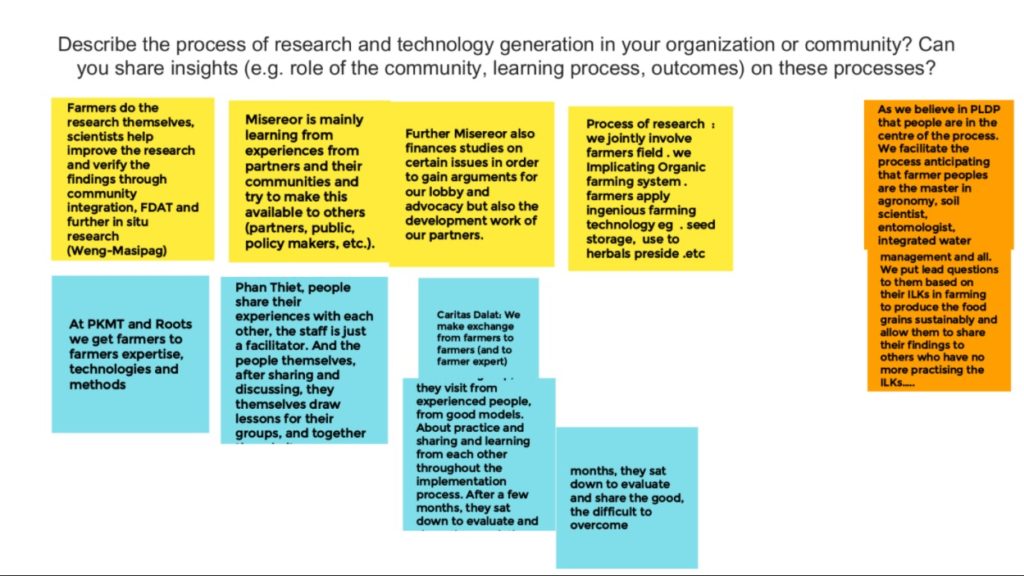
Along with exchanging experiences and insights, Hermann Rupp of MISEREOR shared his insight on democratizing science as a strong argument for agroecology. However, with the dominance of the logic of the current system undermining agroecology by advancing the commercial propagation of genetically modified organisms (GMOs) such as GM yellow rice, especially in the legislative aspect, Rupp asked, “how should we make the public and the politicians understand that agroecology is the answer to food security?”
APEX partner Wali Haider of Roots for Equity from Pakistan, on the other hand, shared his experience on the difficulty of advancing peasant science in mainstream knowledge: “When our expert farmers
went to the judges with regards to their opposition to the Seed Act here in Pakistan, the judges
instantly said that they need scientist experts, not farmers, and right there, the hearing was stopped
and the next hearing, the judges required that expert scientists or agriculturists must be the one
presenting, not farmers.”
According to Dr. Medina, “democratizing science, and ultimately peasant science, can be achieved through practice. While the process is painstakingly slow, it should be consistent. Another way of advancing it is through the lens of social science: legitimizing agroecology, especially the scientific legitimacy of the farmer’s knowledge that is more sustainable and environmentally adequate. Lastly, is (asserting) the political legitimacy of peasant science by using scientific data, practice, and constantly engaging with the public and the politicians which makes the process long yet a persuasive constant communication.”
Adding to the sharing of experiences, Rowena Buena of MASIPAG shared that aside from practical work, which is the heart of the farmers’ organizations activities, they also do a lot of lobbying at the barangay (village) level up to the municipal and provincial levels to ban or at least limit and restrict the entrance of the GM Golden Rice in their area. The farmers learn how to lobby in which they also learn to thoroughly articulate their sentiments and opposition to corporate-led solutions such as the Golden Rice.
Synthesizing the discussion and insights of the participants, APEX Co-coordinator and facilitator for the discussion, Alfie Pulumbarit of MASIPAG, asked the participants: “Whom should science serve?”.
Democratizing science is about making science genuinely accessible to and beneficial for the people. In agriculture, it is about making farmers develop the capacity to grasp the rudiments of science as a powerful tool of knowledge that can lead to the development of more location-specific technologies. Finally, democratizing science and promoting peasant science offers hope that genuine food sovereignty and a pro-people food system can be achieved.
PAN Asia Pacific (PANAP) and MASIPAG, with support from MISEREOR, are coordinating the APEX Platform, which aims to help strengthen the capacities of peoples’ movements in Asia to achieve food sovereignty through agroecology, advance people-led development strategies and approaches, and engage in advocacy for meaningful and pro-people policy reforms in food and agriculture. ###