

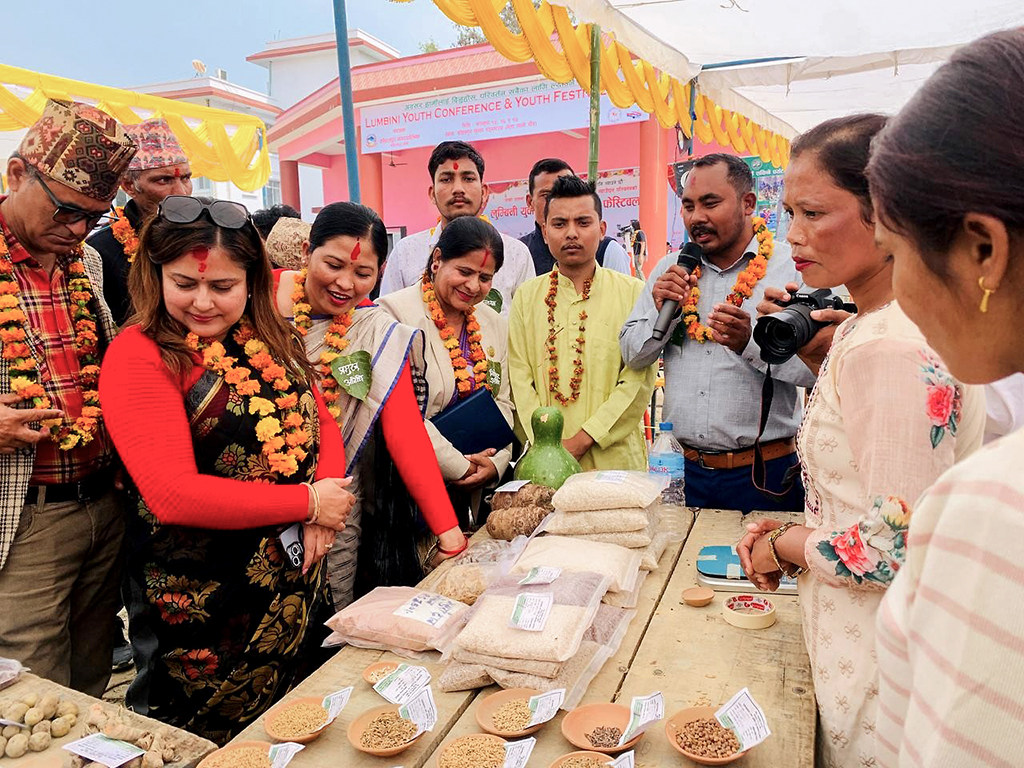
What started as concern about the future of farming is slowly turning into collective action. Young farmers in Nepal are building a nationwide network for change, rooted in the belief that agroecology is not only about crops, but about relationships between people and land, between generations, and between knowledge systems. Despite persistent cultural barriers and limited policy implementation, over 200 young people are now practicing agroecology, and more than 1,000 members are involved in this national network. In this article, some of the network’s leaders share their insights.
In the early mornings of rural Nepal, farmers walk their fields before the sun rises. The soil is cool underfoot, and for a moment, the land feels familiar. These fields once fed families, shaped our culture and gave people dignity. But today, many of us walk with worry rather than hope.
We were producing food, but losing control over our land, our seeds, and even our health. We grew up seeing farming as more than work; it was life itself. Seeds were carefully saved, exchanged with neighbours, and passed down through generations. Birds filled the sky, insects lived in balance, and the soil was alive. Over time, that balance began to break. Little by little, the soil grew tired. Chemical fertilisers replaced compost, indigenous organic fertilisers and manures. Pesticides were sprayed without proper knowledge or protection. At first, yields seemed to increase, but the cost was hidden. Birds disappeared and beneficial insects vanished. Farmers began to suffer from skin problems, respiratory difficulties and long-term health issues. We were producing food, but losing control over our land, our seeds and even our health.
“You feel trapped,” one young farmer told us. “You depend on inputs you don’t understand, and you can’t farm without buying some every season.”
Seeds, once the heart of farming households, are no longer in farmers’ hands. Indigenous and native varieties, well adapted to local climates and resilient to pests and drought, are rapidly disappearing. Instead, farmers are forced to buy expensive seeds from big companies every year. If the crop fails, the debt remains.
Farming has become more uncertain and undignified. Although policies exist to support farmers and youth, these often remain confined to documents rather than extending to fields, and smallholders struggle to meet eligibility criteria for subsidies and programmes.
Climate change has made everything even harder. Rain no longer follows predictable patterns. Droughts last longer. Floods wash away crops overnight. Pest outbreaks have become more frequent and severe. Smallholder farmers – especially women, Dalits, Indigenous peoples, and land-poor households – are the most affected, yet they are often excluded from government programmes and decision-making spaces.
Many farmers feel invisible. “It feels like the land is dying,” an elder farmer told us quietly. “And with it, our way of life.”
Authors: Ashish Thani (27) is an agriculture and community development professional serving as convener of the Agroecology Youth Network Nepal. Ekendra Prasad Devkota (34) is the coordinator of the Agroecology Youth Network Nepal and a rural youth changemaker actively promoting agroecology at the grassroots level. Laxmi Prasad Dhakal (28) is an agriculture professional with expertise on insect pest and disease management. Rachana Poudel (27) is an environmental professional with expertise on climate change and pollution.
Read the full story: https://rooted-magazine.org/2026/04/23/reclaiming-roots-youth-leading-the-agroecology-movement-in-nepal-4/